Visar inlägg med etikett ktv. Visa alla inlägg

torsdag 21 juli 2016

Mandopop: Qi Qi Ge (琪琪格)


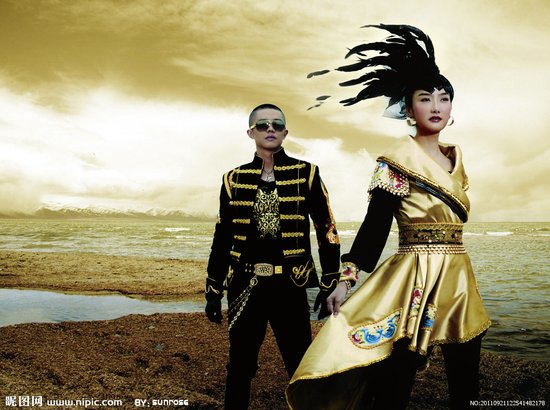
Qi Qi Ge was born in Ordos in Inner Mongolia in 1984, and her mongolian heritage is very evident in her singing, with symbolism and texts very much praising the virtues of the prairie and its people. Still, she studied pop music in Beijing and particpated in a TV contest for music (in 2006) before releasing her first album. After that she has done musicals, acting and other performances. What caught my eye is the passionate "People of the Prairie", which she now even has made a dance edition of, perfect for teh KTV (karaoke) crowd. :-)


onsdag 13 april 2016

Mandopop: Wang Lin - I am a singer (我是歌手)


Some of my chinese friends won't like it when I say this, but this video is a very typical chinese video - cheezy, overloaded kitsch...and very charming. Wang Lin has been one of my favorite KTV (karaoke music) singers for a while, she has this semi-nerdy charm that really makes you love all of it.


fredag 11 mars 2016

Mandopop: Nine Month Miracle - Tread Tread Tread (踩踩踩)


I wrote about this chinese duo some two years ago, and while they really are mostly producing KTV (karaoke) videos, the song "Tread Tread Tread / Come On" from this winter is rather funny and has gotten several follow up videos.


torsdag 3 mars 2016

Mandopop: Zhengyue Shiwu (正月十五)


Just as the muslim calendar, the Chinese calendar is lunarbased, and it would mean that the New Year would move around the year just as Ramadan does, but instead China (like the Gregorian calendar) inserts extra time. In China this means one extra lunar month every three years, and this reduces the New Year to vary between January 19th and February 18th.
So, the New Year falls on a new moon and it formally lasts 15 days when there is the by now rather famous Lantern Festival which has been popularized and spread to many countries in the world. This date is called "正月十五" which literally means "First Month 15th", which also (this was one long preamble...) is the name of the duo singing the catchy "Little Grape", just released suitably enough during the Lantern Festival.


torsdag 23 april 2015

Mandopop: Xiao Zhiming & Chen Wei - Most Beautiful (倍兒美)


CCTV music competition "Avenue of the Stars" evidently has this special where artist combine to special groups (not that unusual in this kind of competition, to be true) and this (天喜果組合) is the result of one of them. The title "倍兒美 / Bei er mei" is Beijing dialect and means roughly "Most Beautiful". The song has become quite popular and I can understand why, it is a very charming KTV style ballad.


fredag 20 mars 2015

Wang Lin - Yami Butterfly (雅美蝶)


"Yami Butterfly" is really rather trivial KTV (chinese karaoke) music, but I am somewhat weak for Wang Lin's charming and happy songs.


söndag 15 februari 2015

Mandopop: Phoenix Legend (鳳凰傳奇)


The folk music duo Phoenix Legend got their big breakthrough in 2005 with their participation in a talent show, but it is their hit "Most Dazzling Folk Style" that is their big hit up to date. With the new "Best of Times" they try to update their style. It actually works quite OK, as long as you are used to Chinese KTV (karaoke) as the baseline for this kind of music. Curiosa: they are part of a military music unit who has as their duty to entertain the army's nuclear weapons division. ;-)


fredag 30 januari 2015

Mandopop: Wang Lin - Simida (思密達)

Obviously Wang Lin is taking her cue from Korean dramas in this video where she uses korean loan words like "oppa", and I am pretty sure the name of the song "Simida" is a korean word but I'm not sure which. It could be "습니다" which is a general ending for making a sentence more formal. A chinese friend says it should be meant as a chinese spelling of the korean word for darling (which one would that be, "salang"?). But I don't know. Anyway, for some reason I love this KTV (karaoke) song. The prelude is just fantastic electronica too. Don't miss her other good songs like "Shang Bu Qi".